
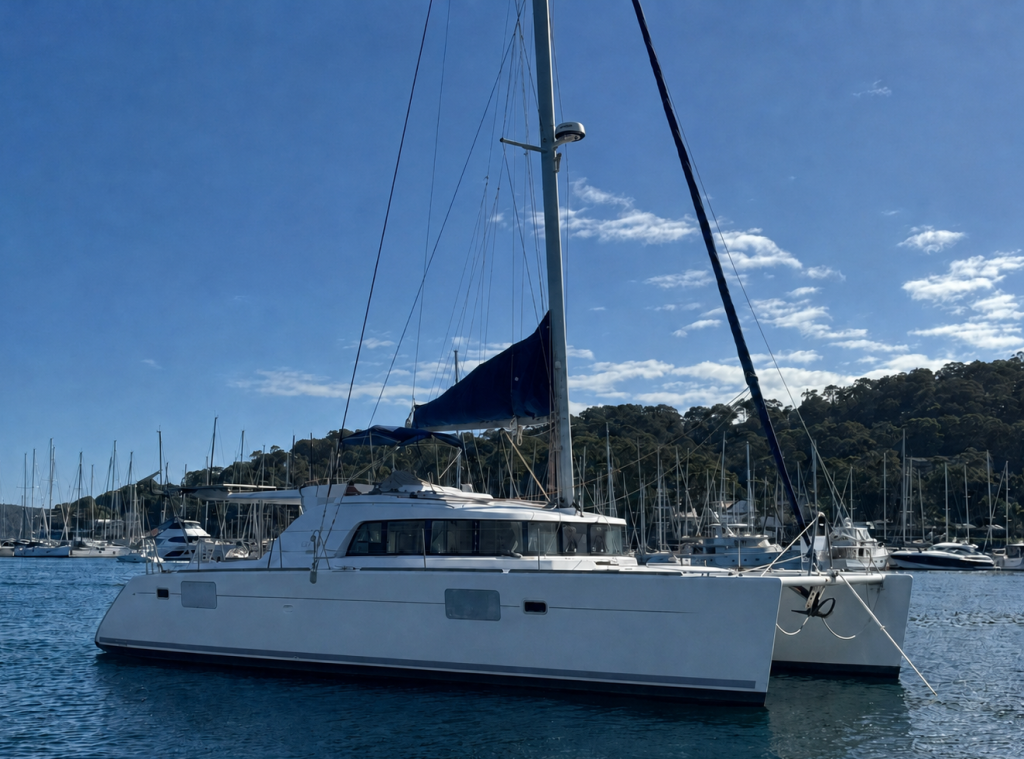
One year, eight coats of varnish and a ton and a half of wood removed — inside Moshe's composite reimagining of a 2006 Lagoon 440.

Most refits are cosmetic. This one is structural. S/V Spartan, a 2006 Lagoon 440 listed at 46 feet, has spent the better part of a year under the hands of Moshe, who set out to answer a question production catamaran owners have been asking for decades: what would it take to turn a well-loved cruising platform into a genuinely stiff, genuinely fast blue water boat?
His answer was subtraction. As Moshe explains on camera, virtually every piece of interior joinery that was once wood has been replaced with honeycomb composite — material he describes as weighing roughly 10% of the timber it replaces. “It’s like air,” he says, holding up a panel, “and it’s super stiff and strong.” The tally: about 1.3 tons of material removed, roughly 100 kg put back in, for a net saving of some 1.2 tons — around 10% of the boat’s weight.
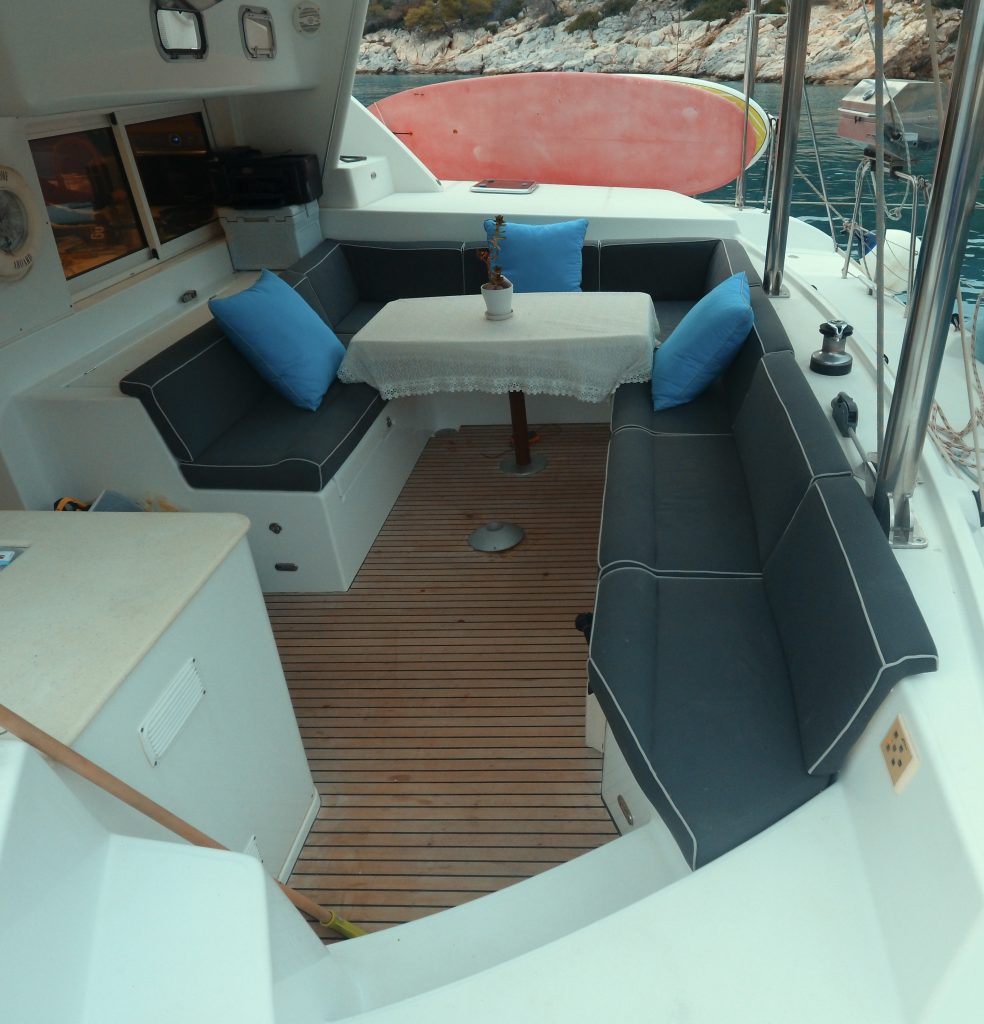
Light, but not cheap-looking
Lightweight doesn’t mean austere here. The honeycomb cores are skinned in 1 mm real teak veneer and finished with eight layers of varnish, each sanded back between coats. In the galley, the same material forms the cabinet doors — moulded to a curve — topped with 6 mm Corian over a composite core, doubled to 10 mm where it matters. “You can dance on it,” Moshe says. The floors are honeycomb too: waterproof, light, and, in the words of the tour host, “a factory finish floor.”
Everything glassed in
The clever part is that the furniture is doing structural work. On a standard production catamaran, cabinets and tables are simply fitted; here, every cabinet and table is glassed to the hull sides and the floor, laminated under vacuum so the interior becomes part of the boat’s structure. “The whole boat is one solid piece,” Moshe says. “When the boat is sailing in a big wave, nothing creaks.” Bulkhead tabbing has been replaced, and the mast compression boxes rebuilt — also vacuum-bagged — which the tour highlights as critical, since the rig’s loads pass down through the main bulkhead and across the boat.
Both men are candid about why. Wide production catamarans from the big yards are, in their words, excellent platforms that weren’t born as blue water boats — they flex, and flexing eventually fatigues. Reinforcing while keeping weight down is, they argue, exactly the right intervention for serious cruising.
The performance case
The goal, Moshe says, was a boat capable of 200–240 nautical miles in a good 24 hours — “not a super racing boat, a cruising performance boat.” Reduced weight, an extended waterline and added stiffness should deliver meaningfully more speed: 8.5 knots where you once saw 7. Over a 12-hour run, that’s the difference between arriving in daylight and arriving in the dark. Under a big asymmetric in light air, he claims the boat can sail close to apparent wind speed.
At the time of filming the project was around 95% complete, with new mattresses and upholstery still taped and covered. Some 80% of the interior has been replaced, along with the flooring in the generator and engine compartments, cabins and galley, plus a large new 110V fridge-freezer. As the host puts it, the new owner will be the first person to sleep in the bed.
Where the 440 market sits
For context, the Lagoon 440 remains an actively traded model on YachtSite.
| Metric | Figure |
|---|---|
| Sold, last 24 months | 16 |
| Median sold price | $320,000 |
| Median time to sell | ~151 days |
| Active listings | 8 |
| Asking range | $149,995–$375,000 |
| Median asking | $337,000 |
“For me, it’s a passion,” Moshe says near the end of the tour. “That’s why I’m good at it — because I do it with love.” After a year of vacuum bagging and varnish, it’s hard to argue.
View the full listing on YachtSite.com
| Lowest asking | $149,995 | |||
| Median sold | $320,000 | |||
| Median asking | $337,000 | |||
| Highest asking | $375,000 |