
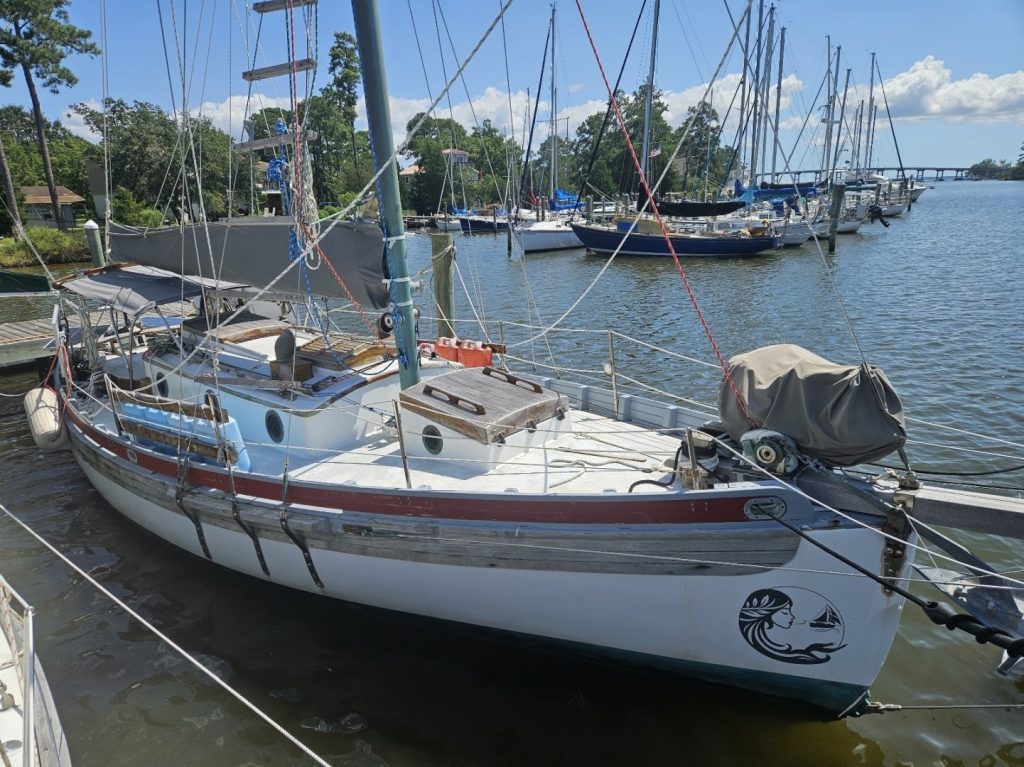
Fourteen months in a Dominican boatyard turned a neglected classic into a proven bluewater home — and now Artha is looking for her next skipper.

Some boats are sold on brochure specs. This one is sold on evidence. The video tour of S/V Artha, a 1978 Bristol 28 Channel Cutter, isn’t a staged walkthrough of an empty hull — it’s a visit to a lived-in home, guided by the young woman who tore the boat apart, rebuilt it herself, and then sailed roughly 700 nautical miles through the Bahamas to prove the work held.
Nicole bought Artha as, in her words, “a disastrous fixer upper” in a swampy boatyard in Luperón, Dominican Republic. The boat had been lived aboard at a dock but hadn’t sailed in at least a decade. Everything, she says, was broken in some way or another. Fourteen months later — through dengue fever, a full bottom job she did entirely by hand, and a mast that had to come out and be stripped to bare aluminum — she sailed it away.
A small boat with big-boat intentions
Twenty-eight feet on deck, cutter rigged, long keeled, with a transom-hung rudder: this is the traditional Lyle Hess formula for a small ocean voyager. She’s about 10 feet of beam and draws roughly 4’10”. A bowsprit reaching more than six feet forward and a boomkin aft push her overall length to just over 37 feet tip to tail — which is exactly why she looks like far more boat than her numbers suggest.
Forward, the working sail plan is genuinely useful rather than decorative. The Yankee-cut jib rides on a Harken Ocean furler, cut high so it tacks cleanly past the inner forestay instead of snagging on it. Inside that sits a hank-on staysail — the offshore insurance policy. As Nicole puts it, if the weather turns mid-ocean you drop the jib and the staysail is still there, drawing, with the inner stay adding support to the rig. The mainsail is set on an unusually long boom (around 15 feet) into a stack pack Nicole sewed herself; she worked professionally as a canvas and sail sewer in Fort Pierce and Key West before going cruising. Halyards are led aft so sail handling can be done from the cockpit rather than on a wet foredeck. Rat lines on the shrouds give easy access to the first spreader, where she added her own spreader lights.
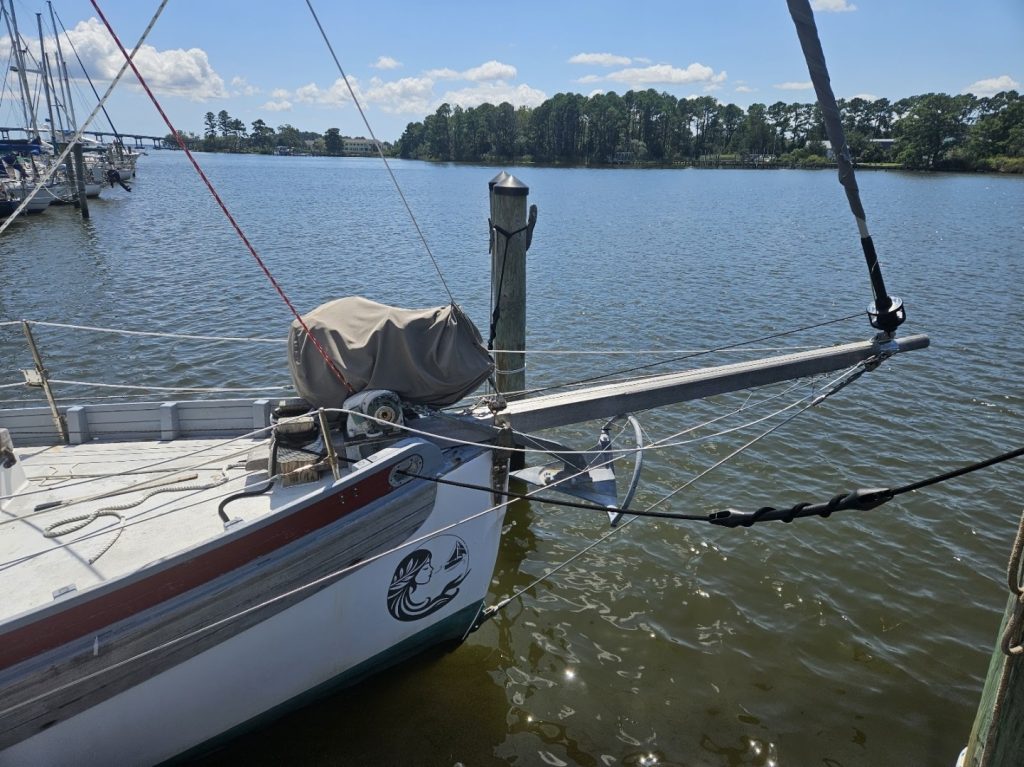
Ground tackle is offshore-serious for a 28-footer: a 45 lb Mantus anchor on 120 feet of 3/8″ high-test chain plus another 175 feet of 1/2″ three-strand nylon rode, handled by a manual windlass. Nicole retrieves all of it by hand and calls it manageable — though she notes a second bow roller on the sprit would improve the angle. Her only wish-list item on the entire foredeck, essentially.
The electrical system is the headline
Ask Nicole which refit project she’s proudest of and she doesn’t hesitate: the electrical. She started from a blank slate and, rather than defaulting to propane and a minimal house bank, built a system efficient enough to run an all-electric galley.
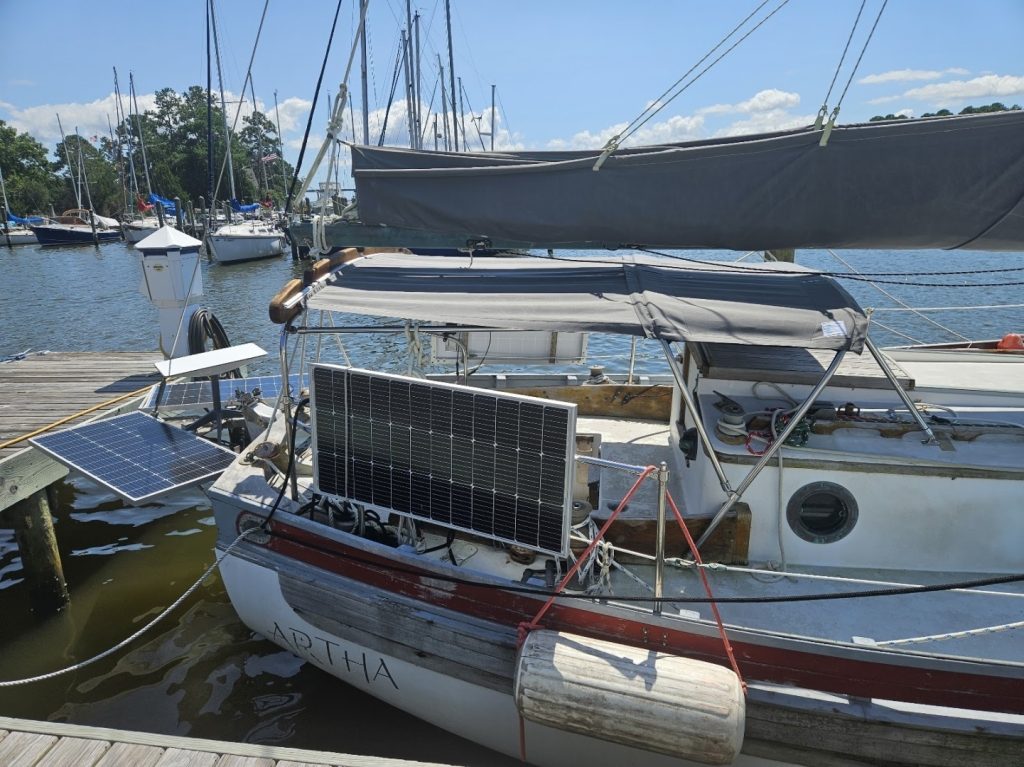
There’s 600 watts of solar aboard — 200 on the cabin top, 200 on a panel she can tilt to chase the sun, and 200 on the boomkin boards — feeding a lithium bank through six solar charge controllers, with a 3000-watt inverter, a separate start battery, a backup battery for the lithium system, and a battery charger. Off that she runs an induction cooktop with a griddle, an air fryer oven (she makes a case for it with brownies and rotisserie chicken), an electric kettle, an Engel fridge/freezer, Starlink, and a watermaker producing roughly two gallons per hour. During the tour she demonstrated making water while the inverter was live and noted the voltage barely sagged.
Auxiliary power is a Yanmar-style 3GM30F, 27 horsepower, which she reports has been reliable apart from a water pump shaft. She carries about 40 gallons of diesel total (30 in the tank, the rest in deck jugs) for roughly 400 nautical miles of motoring range, plus 70 gallons of water — 50 in tanks, 20 on deck — backstopped by the watermaker.
Below decks: a real home, not a weekender
Headroom suits a five-foot skipper better than a six-foot videographer, but the layout is thoughtfully worked. Nicole removed the saloon table — it folds up out of the way — to create open floor space for yoga and workouts. Two pilot berths flank the cabin, each with lee cloth panels and storage beneath; on passage you simply sleep on the low side, wedged comfortably against the hull as she heels. She sleeps in one, guests take the other.
The galley includes a foot-pumped sink, an Engel fridge/freezer, and her Sailrite sewing machine mounted right there in the working space (a second, lighter domestic machine lives forward). Storage is relentless: provisions under berths, in lockers, in every cavity — pasta, flour, olive oil, and, as discovered on camera, pie crust and three flavors of filling. Alfalfa sprouts grow in a jar by the sink.
Forward, the V-berth now serves largely as a storage and workshop area, with an Airhead composting toilet relocated from its original position under the trapezoidal shelf. Nicole empties solids two or three times a year and liquids about every three days. The big forward hatch opens aft — a detail she points out as deliberately offshore-minded, so a boarding wave pushes it closed rather than scooping water below. A butterfly hatch amidships and dorade-style scoops keep air moving.
In the cockpit, the seats have been decked over into a large flat lounging platform; lift the boards and you’ll find a small spin-dryer washing machine and a pump. A handsome wooden boom cradle takes the boom’s weight when the sail is stowed, and the boom can be slung to one side to give the solar panels a clear view of the sky. Steering is by tiller — removable, roughly 15 pounds — with an autopilot attachment point and a cleat and block rigged for sheet-to-tiller self-steering, an old-school trick she uses to let the boat steer itself off wind pressure alone.
Why she’s selling
Nicole is candid about it. She’s accomplished what she set out to do as a solo sailor — including a genuinely frightening first passage from the Dominican Republic to the Bahamas, when she’d never sailed the boat and didn’t know what would fail — and she’s ready for a different chapter. She still loves sailing; she’s simply done doing all of it alone. The boat, she says, has done everything it was supposed to do: “The mast isn’t falling down, the rudder’s not falling off. Everything’s working great.”
Where the market sits
Bristol 28 Channel Cutters trade rarely, so context is thin but worth knowing:
| Metric | Figure |
|---|---|
| Sold, last 24 months | 1 |
| Median sold price | $70,000 |
| Active listings now | 2 |
| Asking range | $39,500 – $129,000 |
| Median asking | $84,250 |
| Median sold (24 mo) | $70,000 | |||
| Median asking (active) | $84,250 |
For a buyer, the appeal here is straightforward: a proven Lyle Hess–designed pocket voyager whose systems were rebuilt from scratch within the last few years by someone who then went and used them hard, and who can tell you exactly what was done and why. She’s small, she’s simple, and she’s demonstrably capable of carrying one person and a dog a long way in comfort. For details and to arrange a viewing, contact Jim Edwards.