
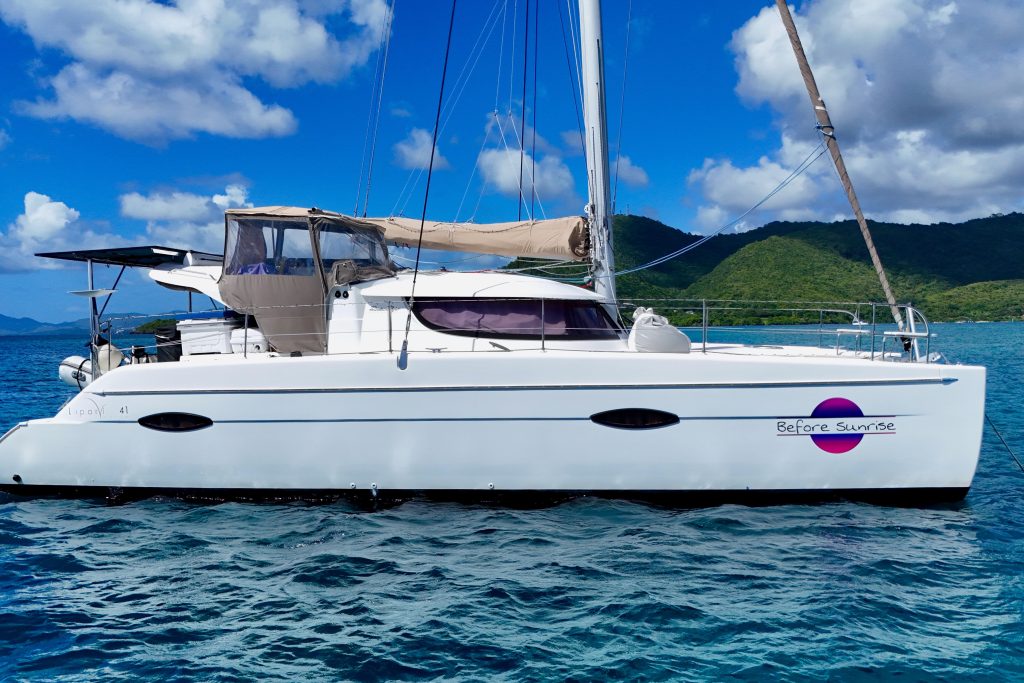
New engines, three-year-old rigging and 2,000 watts of solar — a full-time liveaboard catamaran in Grenada that actually looks the way its listing photos promise.

Filmed on a mooring in Prickly Bay, Grenada, this walkthrough of S/V Before Sunrise — a 2015 Fountaine Pajot Lipari 41 — is less a highlight reel than a conversation between two people who have crawled through a lot of catamarans. Chris Rundlett of LTD Sailing School and Yacht Brokerage, affiliated with The Multihull Company, is joined by Chrystal, and the pair spend the better part of an hour picking through the boat’s systems, its upgrades and its handful of honest to-do items.
They even sort out the name of the model itself: Lipari, as in the island off Sicily. Length, too, gets a wink — it’s called a 41, but the hull is really about 39 feet. That distinction matters later, when the conversation turns to how much boat has been packed into the footprint.
A private boat, not an ex-charter
Provenance is a big part of the story here. The current owners bought the catamaran three years ago from a gentleman who owned a charter company — but this particular boat was never in charter. It was his personal boat, lived on and, by his own account, rarely taken off the dock in seven years. The current family has been considerably more adventurous: they sailed to the Bahamas and then down through the island chain to the Caribbean, and have lived aboard full time with their kids ever since, homeschooling as they go. The reason they’re selling is straightforward: it’s time to put the children in school.
Chris makes the case that a full-time liveaboard owner is usually the best kind of custodian. Problems get found and fixed as they appear, rather than compounding while a boat sits unattended on the hard for six months.
The big-ticket items, already ticked off
Chris walks through his mental checklist for any used cruising boat: is the hull sound, how old are the sails, how old is the standing rigging, and what shape are the engines in? On Before Sunrise, two of those answers are unusually good.
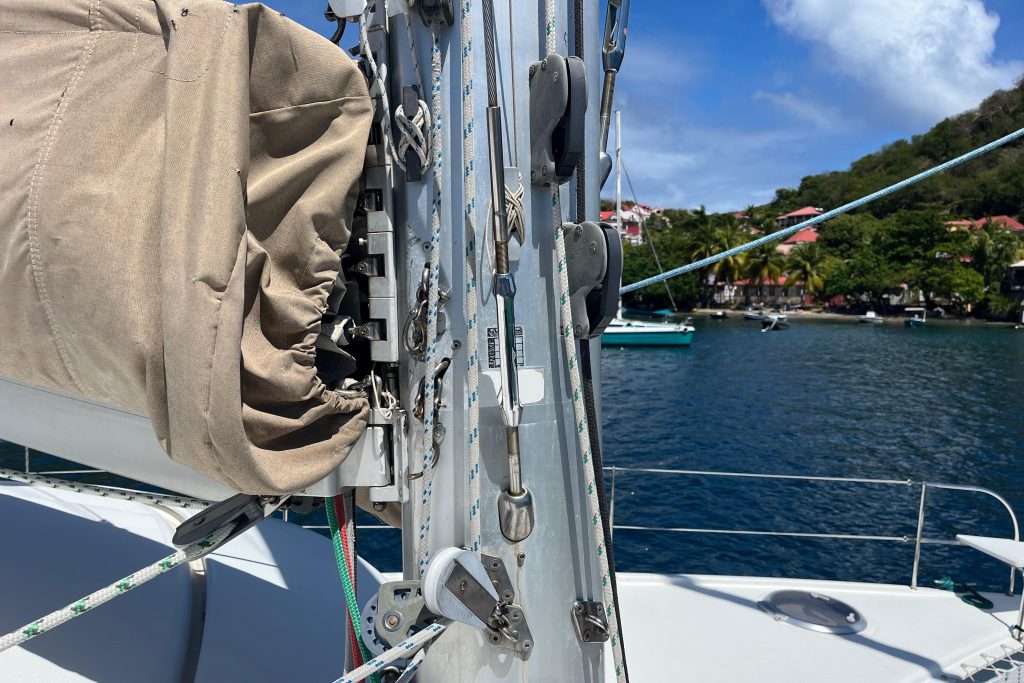
The engines were replaced in 2023 — the result of the Volvo emissions issue that affected US-registered Fountaine Pajots — and carry just under 700 hours. As Chris points out, a 2015 Lipari that had done charter service could plausibly be sitting on 5,000 to 6,000 hours by now. Starting fresh under 1,000 hours, he says, effectively puts years of life back into the boat. The standing rigging is only three years old, against the roughly ten-year replacement interval insurers typically expect on a catamaran, so there’s plenty of life left there too.
The engine compartment gets a nod as well: clean, tidy, Volvo green paired with a rack of blue Victron gear. “A clean engine room is a good sign on any boat,” Chris notes.
Solar, lithium and hot water for free
The first thing Chris noticed stepping aboard was the large solar arch across the transoms. Four bifacial panels there feed two MPPT controllers (two panels each), while the original panel on the hard bimini has its own third controller. Peak midday output in summer is reported at around 2,000 watts, charging a 600 amp-hour lithium bank. Chris calls that a deliberately conservative and efficient ratio — plenty of charging capacity for the bank, rather than the other way around. The arch also throws welcome shade over the aft deck.
The clever part: once the batteries hit float, typically by mid-morning, surplus solar is routed through the inverter to the water heater. Chris admits he normally considers electric water heating wasteful, but when it’s free energy that would otherwise go unused, it’s hard to argue — hot water for dishes and laundry without touching the generator.
Liveaboard details that show real thought
At the starboard transom sits a standalone washing machine with a separate spin extractor, tucked under its own sunbrella-style cover so it looks like it belongs there. On a 39-foot hull, Chris explains, a built-in washer would eat an entire locker — and since you’ll be line-drying outside anyway, putting the machine outside is simply efficient.
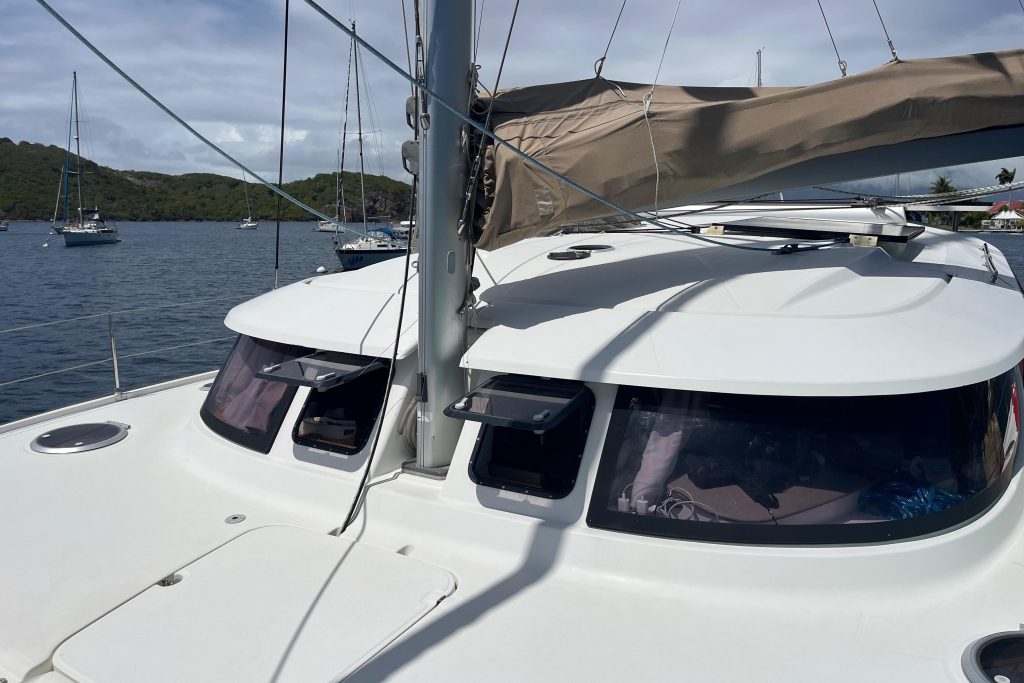
Forward, the trampolines are new and black, which both hosts prefer for the see-through-to-the-water effect. The lifelines are custom Dyneema. The gooseneck has its Delrin washers, serviceable if not new. Below, the emergency escape hatches have the upgraded frames with bolted-in — not just glued — lenses, addressing a known industry issue. Chrystal flags the round ports and deck hatches, which she finds age better than square ones.
The cockpit carries shade enclosures all the way around plus a full weather enclosure at the helm. Inside, the galley has a double stainless sink, propane cooktop, microwave and oven, a two-drawer fridge with a compartmentalized freezer above — and an ice maker that, Chris confirms mid-video, stays with the boat. The saloon table has just been refinished and drops down with a filler cushion to create a large daybed; the family use it, with a screen rigged in the cockpit doorway, for movie nights. That was Chrystal’s favorite feature.
The layout is four cabins and four heads, each cabin with its own ensuite. They’re wet heads, and Chris is candid about the trade-off: you gain privacy, you give up shower space compared with newer two-cabins-share-one-big-head arrangements. For this family, the spare cabin doubles as a lockable office with a small table and monitor. The boat also has air conditioning and a generator, though Chris muses that with this much solar already installed, it would be a strong candidate for a modern 12- or 48-volt AC system.
What still needs doing
Honest disclosure is part of the appeal here. The mainsail cover is original, ripped and due for replacement — an opportunity, Chris jokes, to put your own boat name on it. The owners are also preparing to do some running rigging work, though he makes the point that running rigging is replaced piece by piece as it wears, not all at once. Nothing he saw looked tired or unserviceable, and hull condition he defers, properly, to a surveyor.
Where it sits in the market
Chris is upfront that Before Sunrise is currently priced at the top of the Lipari 41 market, with others close behind — and equally upfront about why he thinks the equipment list and condition justify it. He contrasts it with another Lipari 41 he recently attended a survey on in Grenada, which looked great in the listing and was rejected before the report even came back.
| FP 41 Lipari market | Figure |
|---|---|
| Sold, last 24 months | 6 |
| Median sold price | $287,500 |
| Median time to sell | ~170 days |
| Active listings now | 6 |
| Asking range | $290,000–$330,000 (median $295,000) |
| Inquiries, last 30 days | 14 (vs 6 prior 30) |
| Median sold (last 24 mo) | $287,500 | |||
| Median asking (active) | $295,000 |
For serious buyers, Chris offers a live video walkthrough of the boat — a no-holds-barred hunt for the ugly bits — noting the LTD Sailing office is right there and the catamaran is on one of their moorings. And, as both hosts promise in closing, they’ll keep the ice cold.