
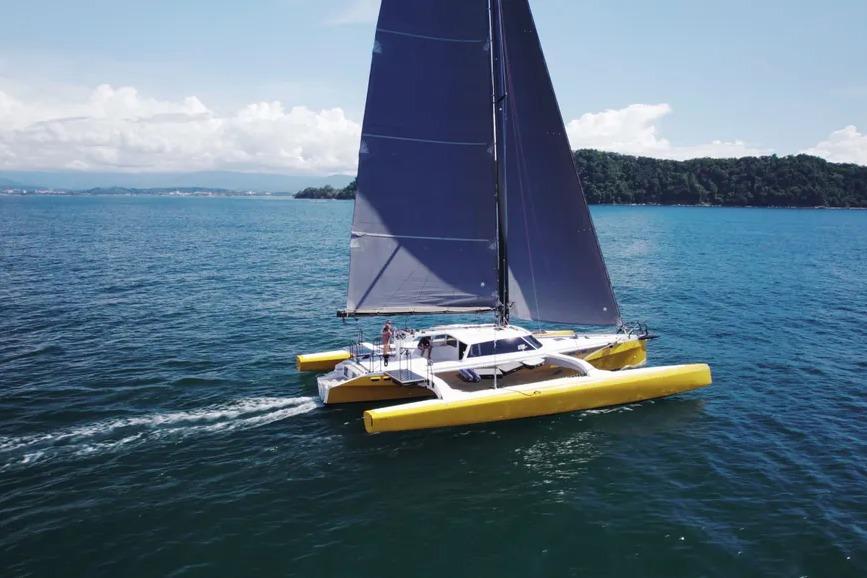
Riley and Elayna Whitworth's three-year passion project — a carbon-fiber Rapido 60 built in Vietnam — opens its doors from Kota Kinabalu.

Few production sailboats arrive with the story that S/V La Vagabonde III carries. Built over three years and launched in 2023, this Rapido 60 is a carbon-fiber ocean-going trimaran whose owners not only helped shape its design but have since lived, sailed, and raised a family aboard her. In a video tour filmed alongside the docks of Kota Kinabalu, Malaysia, we get an unusually candid look at what it’s like to actually inhabit a boat of this caliber — from the Hague Blue galley cupboards to the 43.2 kWh lithium bank tucked below the cockpit sole.
A Saloon Built for Living
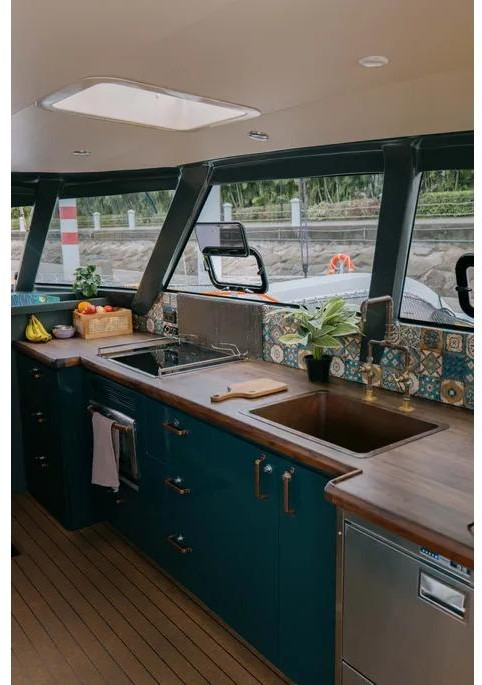
Step aboard and the saloon reads more like a well-designed apartment than a yacht interior. The owners describe it as the space where they spend most of their time, and the reasons are obvious: an open plan, forward-facing nav station, and a galley finished in that deep Hague Blue with copper accents that have already begun their patina from the salt air. Timber trim softens the modernity, and the leather upholstery — remarkably, cut from a donated American couch and reassembled at the Rapido factory in Vietnam — brings a warmth that feels genuinely lived-in.
The galley itself is thoroughly practical: a three-burner induction cooktop, an oven, a large fridge with twin drawers, and a dedicated freezer. A whiteboard-photo wall, a convertible dinette that drops into a berth at night, and a nav station positioned to keep eyes on the horizon round out a space that is at once functional and personal.
Carbon Where It Counts
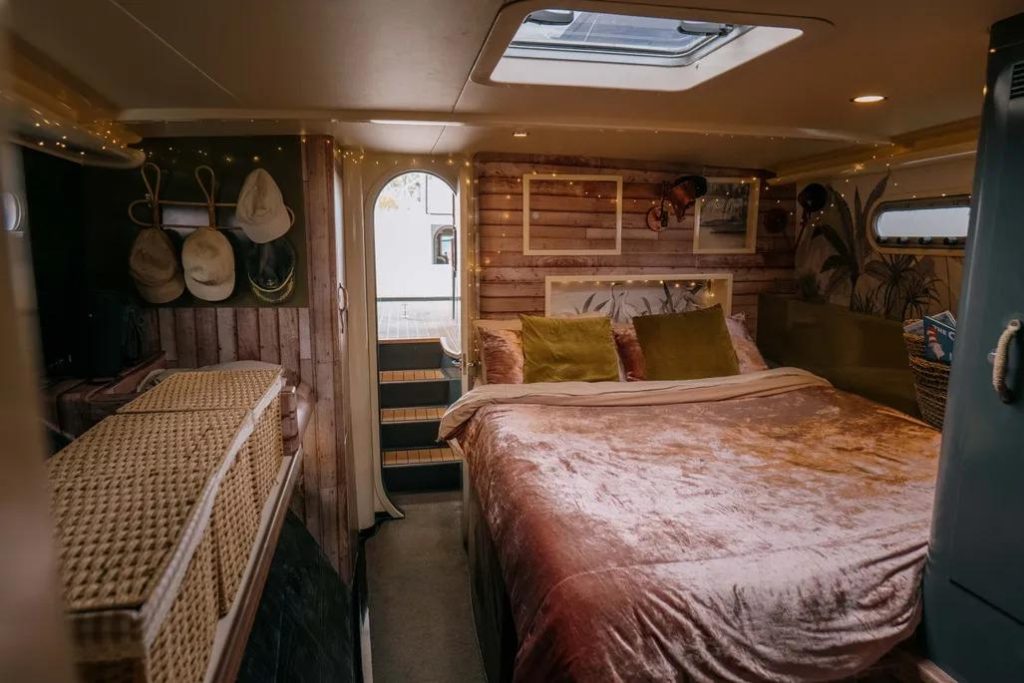
The Rapido 60 is a serious carbon boat, and La Vagabonde III celebrates that in ways the factory itself pushed back on. One large expanse of exposed carbon in the master cabin was a specific request from Riley — a nod to the true material of the hull. The dining table carries a carbon edge, the mast is a rotating carbon spar, the bowsprit is custom carbon-engineered for this boat, and even the OC tender is full carbon. The result is a boat that is fast, light, and honest about its construction.
Two guest cabins carry queen berths, and the master is described by its owner as “hygge” — cozy, tucked-in, and generous with storage. Two heads serve the boat, one styled in a 70s-inspired scheme with copper fittings and patterned wallpaper, the other a cleaner white-tiled guest head. The gas-strut cabinetry throughout — a small detail — draws particular praise: everything opens with a gentle push, and the airflow it allows through the boat is described as feeling like natural air conditioning.
The Engine Room and Hybrid Propulsion
La Vagabonde III runs a hybrid propulsion package: a Yanmar diesel paired with an Oceanvolt electric system, drawing from six MG lithium-ion batteries at 7.2 kWh each — a total of 43.2 kWh. At the time of filming, the diesel had been lifted out following saltwater intrusion (traced to an exhaust loop that wasn’t high enough), and Yanmar was replacing it under warranty. In the meantime, the electric system had already proven itself: a five-hour sail used just 7% of the battery bank, and while crossing the South China Sea at 12 knots the props were regenerating 2 to 3 kilowatts back into the bank.
Safety in the engine compartment is thoughtfully considered. The entire machinery space is sealed and served by a fire-suppression system with a manual pull, reflecting a design philosophy that acknowledges the trimaran’s inherent unsinkability (thanks to three independent hulls) while addressing fire — the more realistic threat — head-on.
On Deck: A Serious Sailing Platform
Above decks, this is unmistakably a performance trimaran. The mainsail measures 122.5 square meters — at least twice the size of the owners’ previous main — and is complemented by a Solent, staysail, Code Zero, and gennaker set on a Facnor furler out on the custom carbon bowsprit. The sails are Doyle Stratis carbon Technora membrane construction, the top of Doyle’s range. Two 470-watt Sun Powered Yachts solar panels sit up on the coachroof, with a further three 170-watt flexible panels that deploy via gas-strut lids to more than double solar input when at anchor.
The daggerboard drops to 3.548 meters and, according to Riley, stays down almost all the time — only being raised in truly extreme sea states. Sail handling is centralized at the mast base, a setup Riley actively prefers for safety. The helm was specified minimally, with the bulky standard cover deleted for weight and aesthetics, and jacklines run to attachment points at the wheel and elsewhere for clipping in.
Perhaps the most telling moment in the tour: in 44 knots of wind with two reefs in, the B&G autopilot on wind-vane mode, performance level 5, held the boat downwind so confidently that Riley describes considering a cup of tea. That is the character of this boat — not just fast, but composed.
The Living Systems
Water comes from a Spectra Newport 700c watermaker, described as easy to run with a good install. The bow thruster and electric windlass handle ground tackle (roughly 60 meters of chain), and the tender is a full-carbon OC — capable of sailing, though its mast currently resides at the Rapido factory awaiting the next visit. Storage throughout is generous enough that the owners admit they can’t fill it, which suits their goal of keeping the boat light.
A Rare Offering
The Rapido 60 is not a boat that comes to market often. As of this writing, this is the sole Rapido 60 listed, offered by Will Miller at $1,950,000.
| Rapido 60 Market | Figure |
|---|---|
| Active listings | 1 |
| Asking price | $1,950,000 |
| Median asking | $1,950,000 |
| Per Battery | 7.2 | |||
| Total Bank (6 batteries) | 43.2 |
For a buyer looking at the intersection of true bluewater performance, modern hybrid systems, and a genuinely personal interior, La Vagabonde III is a rare kind of listing — a boat that has been sailed hard, thought about carefully, and built to a spec that reflects real ocean use rather than showroom polish.