
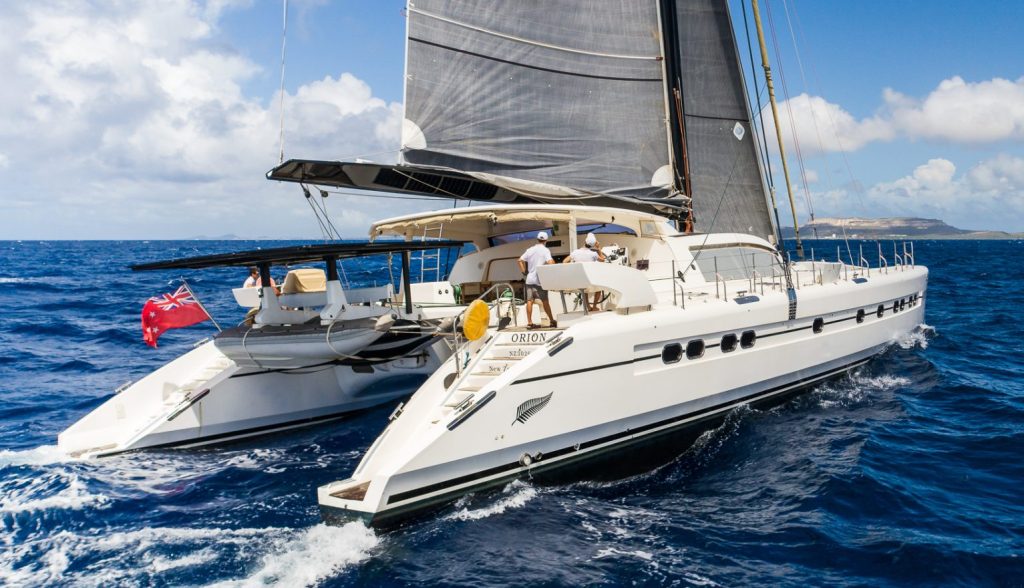
A one-of-one carbon-rigged bluewater catamaran designed by a repeat Catana owner who already knew exactly what he wanted.

There are boats, and then there are boats with a story. S/V Orion belongs firmly in the second category. Wiley Sharp of Catamaran Central steps aboard in Spanish Water, CuraƧao to walk through the only Catana 90 ever built — a 2008 mega-performance cruising catamaran commissioned by an owner who had already circumnavigated aboard a Catana 582 and used that experience to spec exactly the boat he wanted next. As Wiley puts it, recreating Orion in today’s marketplace would easily cost in excess of $10 million.
At 90 feet long with a beam of nearly 40 feet and a displacement just over 70 tons, Orion is unapologetically built around Catana’s founding ethos: performance, safety, and comfort. What makes the tour compelling is how consistently those three themes overlap — a Venn diagram, as Wiley describes it, where a well-designed deck plan is simultaneously faster, safer, and more livable.
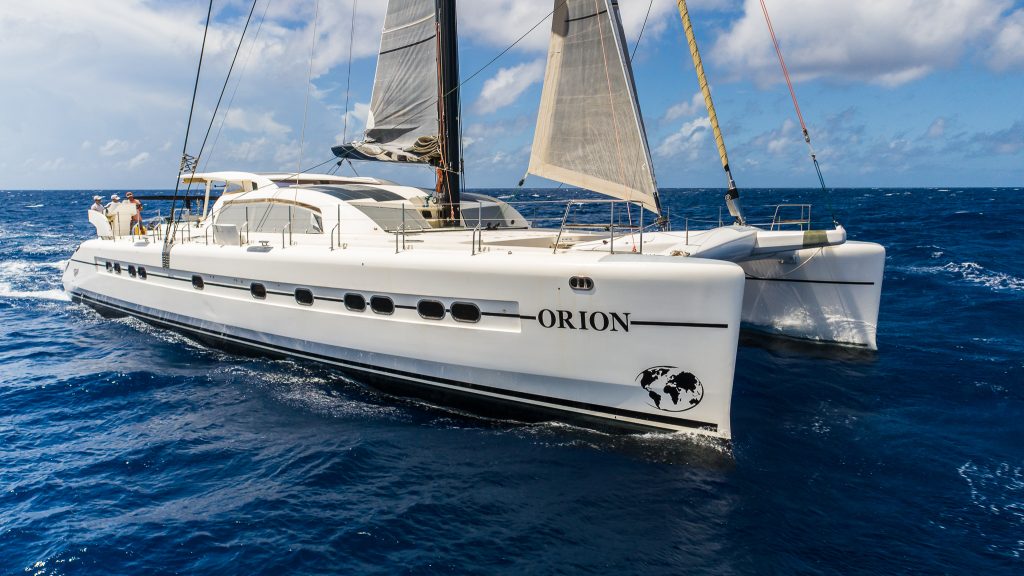
A Rig Built for Real Miles
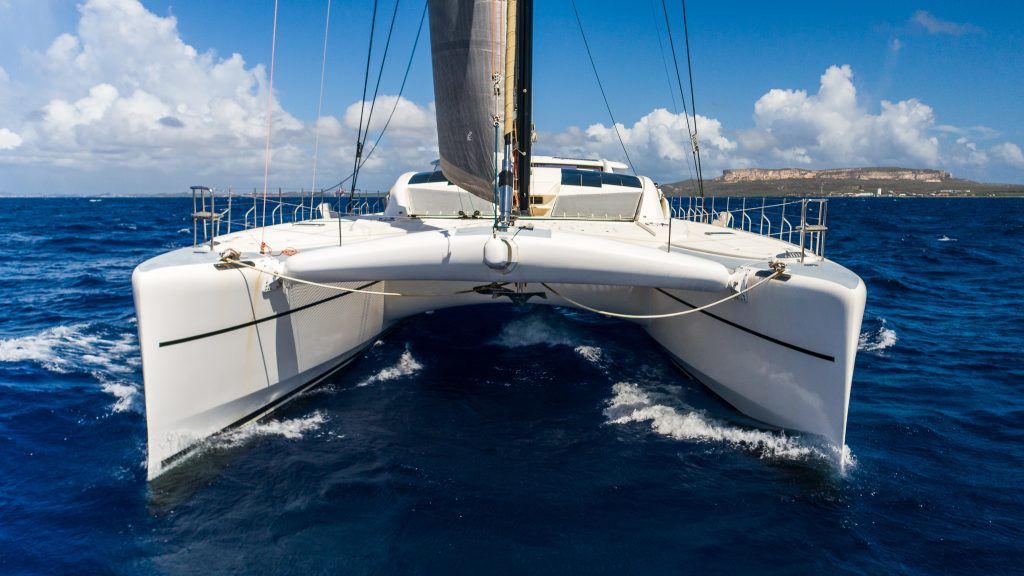
Orion carries a 126-foot carbon fiber mast — recently repainted black — paired with a carbon canoe-style boom and a custom Evolution Sails square-top laminated main from New Zealand. Rigging is Kevlar shrouds from Fabrica Workshop in Spain, an outfit with America’s Cup pedigree, terminated on titanium chainplates. Up on the longeron, integrated into the composite forward crossbeam, sit a staysail on a Facnor furler, a yankee on a Reckmann hydraulic furler, and a tack point for a Code Zero light-air sail.
Wiley describes a day of sailing in gusts to 35–36 knots with two reefs in the main and the staysail deployed, and how gracefully the boat ate up the miles. With daggerboards up she draws about 1.7 m; boards down she goes to just over 4.5 m and will point to 32–33 degrees — genuinely close to the wind for a cruising cat of this scale.
The Deck Plan and Helms
A 26 kW Northern Lights generator drives a hydraulic pump feeding the bow thruster, Muir windlass, and the full Harken hydraulic deck plan — eight hydraulic winches and a hydraulic mainsheet. Twin Harken 980 self-tailers handle halyards and reef lines, a Harken 1111 manages the loaded headsails, and Harken 70s deploy the tender and control daggerboards and traveler. Critically, an emergency kill for the hydraulic system sits centerline plus one at each helm.
The carbon fiber wheels are linked to the rudders with Dyneema cable, giving Wiley the sense of driving a 50-foot performance boat rather than a 90-foot cat. Each helm is enclosed enough to feel genuinely secure in a blow — no small thing on a twin aft-helm platform — and duplicates the B&G instruments, chart plotter, radar/AIS, autopilot, and windlass controls on both sides. The owner currently runs the boat with his two sons; that is a direct testament to how thoughtfully the deck is laid out.
Power, Water, and Range
Orion is engineered to disappear off-grid. There are 10,000 watts of solar in total — 1,600 W on the cockpit hardtop plus 4,000 W of bifacial panels on a custom carbon fiber array over the davits, and additional flexible panels — feeding 25 Victron MPPT controllers and a lithium bank. Four Mastervolt inverters totaling 16,000 W handle the AC side. Twin Sea Recovery watermakers, dual chillers, and two 1,700-liter diesel tanks give Orion the legs to reach places most private yachts never see. Propulsion comes from twin Perkins 215-hp diesels, each with a secondary alternator feeding the house bank.
The bilge system was fully reworked from factory spec into five well-defined bilge areas per hull — the kind of upgrade only an experienced circumnavigator would prioritize.
Living Aboard
The cockpit doesn’t feel like a performance-boat compromise. An oversized daybed sits outboard to port, an L-shaped settee with a custom wood dining table seats ten, and a wet bar with icemaker and a residential-style barbecue anchor the starboard side. Two deep freezers hide beneath the sole, alongside cavernous deck lockers.
Inside, French cherry ceiling detail, Alcantara, and foam-cored cabinetry finished in real wood veneer set the tone — light, strong, and genuinely elegant. The saloon offers a U-shaped lounge with flat-screen and Bose surround; the lower nav station carries a vessel management system, B&G electronics, Victron controls, comms, and fire monitoring, all wrapped around an electronically adjustable helm chair that Wiley admits to being jealous of. The galley features Corian counters, a Gaggenau 5-burner cooktop, Bosch oven and microwave, Balay dishwasher, dual Frigonautica refrigeration, and a purified/mineralized water spigot.
Accommodations are laid out for a family plus crew. The starboard hull houses the owner’s stateroom aft with a king berth, en-suite head, and a proper workstation, plus a forward king cabin and a three-berth bunk room. The port hull carries a convertible twin/king guest cabin, a captain’s quarters forward, and another three-berth bunk room — every cabin fitted with its own custom desk, a nod to the family’s ongoing sailing sabbatical and remote learning.
Context in the Catana Market
Orion sits well outside the typical Catana market — but that market is active. Buyer interest in Catanas has climbed noticeably in the last month, and current asking prices span a wide range depending on model, year, and refit status.
| Catana Market (last 24 months) | Figure |
|---|---|
| Boats sold | 15 |
| Median sold price | $330,000 |
| Median days to sell | ~290 |
| Active listings | 10 |
| Asking range | $349,000–$1,550,000 |
| Median asking | $585,000 |
| Inquiries (last 30 days vs prior) | 14 vs 9 (+56%) |
| Low asking | $349,000 | |||
| Median asking | $585,000 | |||
| High asking | $1,550,000 | |||
| Median sold | $330,000 |
Orion is a singular boat — the only Catana 90 ever built, commissioned by an owner who knew the brand intimately, and finished to a level that rewards close inspection at every hatch and locker. For a buyer looking at genuine long-range, short-handed performance cruising at scale, there simply isn’t another one.