
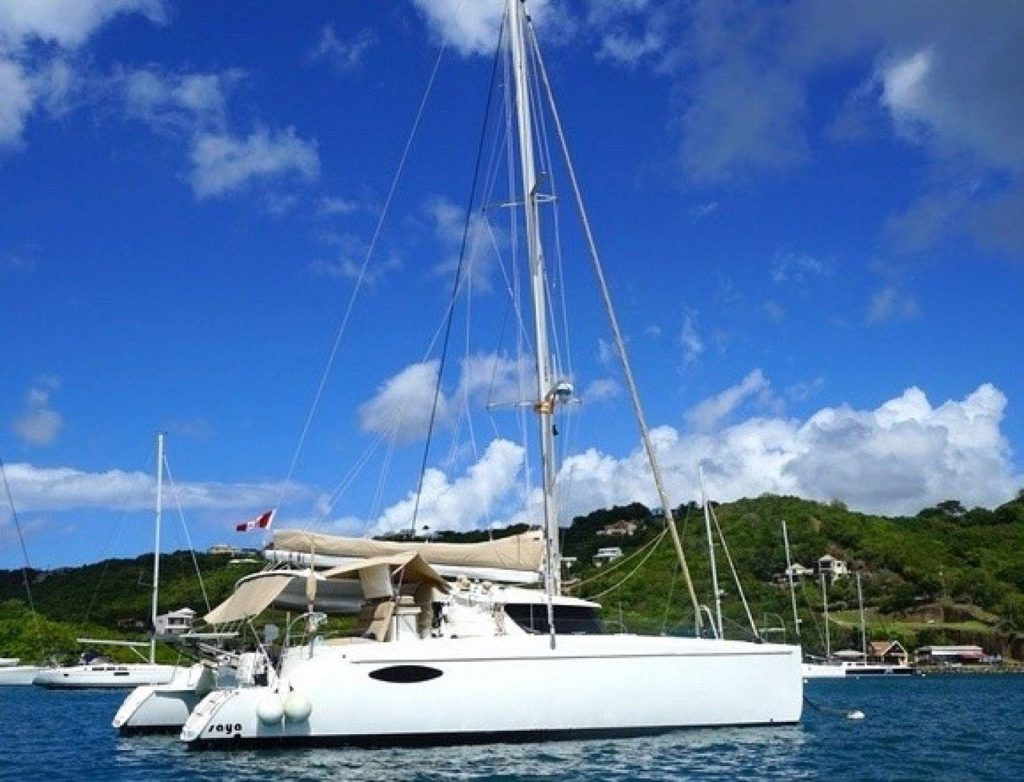
Three careful owners, a workshop where a fourth cabin should be, and a mooring ball in St. George's — this 2009 Maestro-layout cat wears its years lightly.

There are boats that survive fifteen years, and there are boats that are carried through them. S/V Saya, a 2009 Fountaine Pajot Orana 44 lying on a mooring in the marine protected area off St. George’s, Grenada, is clearly the second kind. In a relaxed on-the-water walkthrough, broker Chris Rundlett of LTD Sailing School and Yacht Brokerage — joined by Chrystal — makes the case not with a spec sheet but with the small tells that experienced cruisers notice first.
“You can always just check the floor right in front of the galley,” Chris says. “That’s where everybody’s dropped pots and pans, and it usually shows. But this boat, it does not.” The floors, upholstery and joinery all read newer than 2009, which sets the tone for everything that follows.
Where the Orana sits in the family tree
Chris frames the boat in context: the Orana 44 is the generation that preceded Fountaine Pajot’s Helia 44. Having just filmed aboard a 2011 Lipari the week before, he notes that Saya is the older design of the two — and then immediately points out that you’d struggle to guess it walking the decks. He also prefers one Orana feature over its successor outright: the aft love seat, or chaise, tucked at the back of the cockpit. “One of my favorite features on these boats, and in my opinion a way better setup than what you find on the Helias.”
Power, shade and the systems that matter
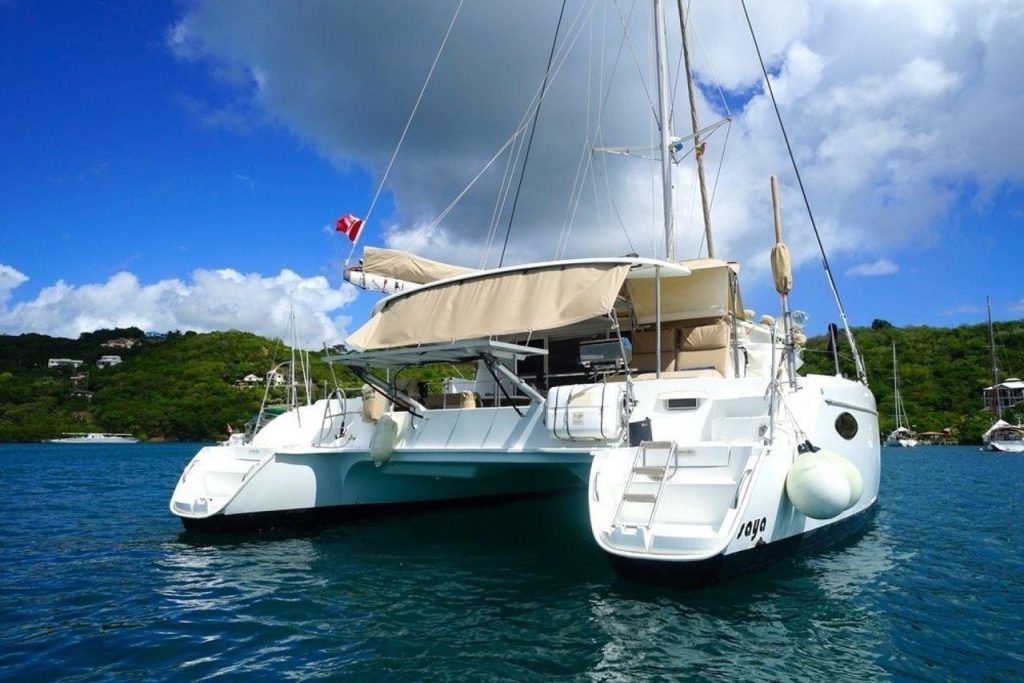
The solar array is generous: four panels on an aft rack plus four larger panels on the cabin top, feeding a bank of eight 105-amp-hour six-volt Trojan batteries. Chris is candid about the lead-acid choice in a lithium-obsessed market — “this is a really good top-of-the-line brand and system for a lead-acid setup,” he says, with advantages of its own and a cost point that’s hard to argue with. Charger/inverters live in each engine space, and the MPPT solar controllers sit with the battery bank beneath the cockpit settee.
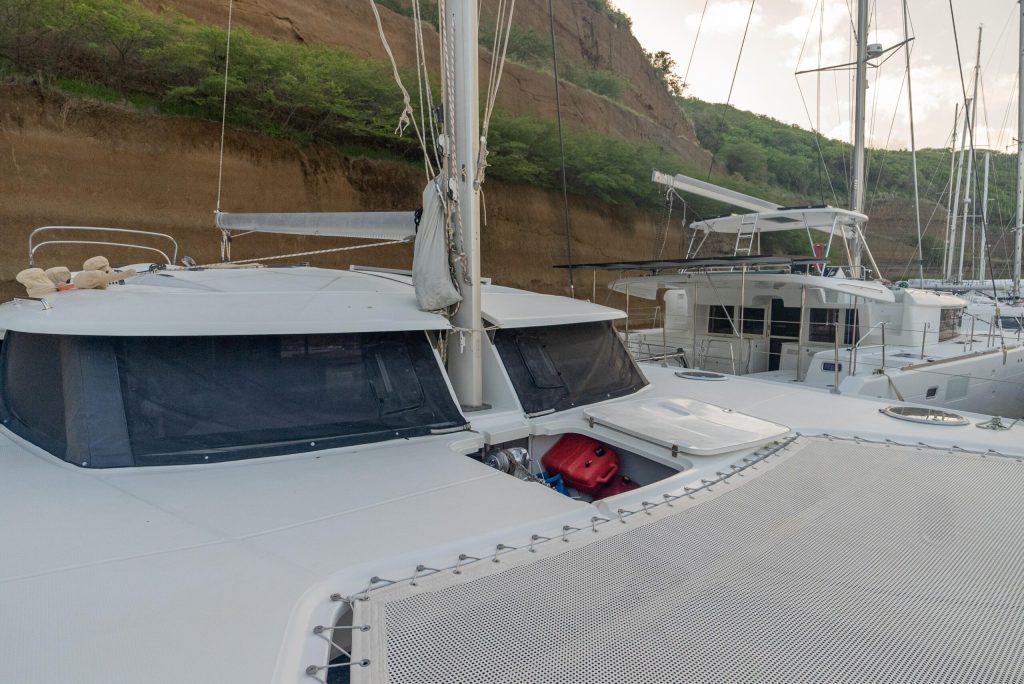
There is no built-in air conditioning, and Chris treats that as a design philosophy rather than an omission. Passive ventilation does the heavy lifting: a large forward deck cover lets you leave hatches and ports open through Caribbean squalls without jumping up at 2 a.m., Bermuda-style shade covers handle the aft end, shade screens cut glare on the big saloon windows, and Caframo Sirocco II fans — Chris’s favorites for being quiet, safe and effective — move air below. When August turns still and stuffy, the owners run a portable air conditioner/dehumidifier off a portable generator, enough to cool the owner’s side into a sanctuary. The upside of skipping a built-in system, as Chrystal points out, is storage: no compressors and condensers eating the space under the settees, and fewer systems to fail.
Sailing the boat shorthanded
The helm station drew praise from the current owner, who told Chrystal it’s her favorite spot on the boat because it catches all the breeze. The bench seats two comfortably, sightlines reach all four corners of the boat, and a shade canopy — not a full bimini or enclosure — takes the edge off the sun.
Instrumentation is honest about its age: older Furuno gear plus some B&G, with chart plotter, depth and wind. The standout is redundancy. There are two entirely separate autopilots — a primary Furuno driving a hydraulic ram, and a Raymarine backup with its own head unit and its own ram. “If you’ve ever been on a boat where the autopilot’s gone out and you had to hand steer for days on end,” Chris says, “you really appreciate that redundancy.”
All lines lead aft to the helm. An electric winch handles the main halyard at the push of a button, and while the two remaining winches are manual, the deck layout allows any of them to be cross-sheeted to the electric winch when you’d rather not grind. Running rigging is high-modulus Dyneema-type line from Maffioli — “really good high quality line that you don’t find on a lot of cruising cats.” The mainsail is new as of 2024; the genoa was replaced in 2021 when the current owner bought the boat. Chris is blunt about why that matters: a new main is easily a $10,000–$15,000 proposition.
Tender handling done sensibly
The davits sit lower than most, which Chris and Chrystal both like — less pendulum swing, less obstructed view aft, and weight kept lower where it belongs. A second electric winch raises and lowers the tender on push-button control, no lines strung across the cockpit. The dinghy itself is a ZAR CL 10, a 10-foot aluminum double-bottom RIB with an 18-hp NS outboard. The double floor lets the fuel tank live in the forward locker with the fuel line run beneath the sole — clean, uncluttered, and, as Chrystal notes, your feet and luggage stay dry. A gas barbecue on the transom runs the widely available green canisters, with a straightforward conversion path to a larger tank if you prefer.
Below decks: Maestro layout with a workshop forward
This is the Maestro owner’s version — three cabins. The two guest cabins to starboard each have their own head. The owner’s hull gets one large head, a big semi-island berth aft with ample hanging and shelf storage, and — where a forward cabin would normally be — a dedicated workshop. Room for tools, spares and supplies. Chris says that space, and the pile of spares that came with it, was the deciding factor for the current owner, an Alaska-based pilot and boat owner who does his own maintenance and reportedly made a full-price offer as the first person to see the boat.
The saloon feels open and airy: good headroom, light-colored wood surfaces throughout offset by dark leather settee upholstery, and Fountaine Pajot’s characteristic rounded cabinet and table edges that spare you the shin-level “boat bites.” The galley runs a three-burner propane stove and propane oven, with a single-basin sink and a draining platform, plus an extra cabinet added by the original owner to maximize storage. Cold storage is doubled up: the original top-loading fridge with small freezer, plus a later front-loading unit that can be set as fridge or freezer — compartmentalized with pop-up interior doors so you don’t dump all the cold air at once. The owners, avid fishermen, switch it to freezer duty when the lines are out and back to fridge when guests are aboard.
Other liveaboard essentials are covered: a Schenker watermaker producing 60 liters (roughly 15 gallons) per hour, effectively rebuilt over the past four years with new filters, membrane, hoses and pumps; and a washing machine that Chrystal — and most cruisers who’ve spent a week with a bucket — considers mandatory. There’s even a retractable clothesline in the workshop for rainy days.
Ground tackle, engines and recent work
Forward there’s a 1,000-watt Lowrance Cayman windlass, 250 feet of new 10mm galvanized chain, a 33 kg Rocna as primary anchor and an aluminum Fortress as a backup — the one you’d want if you ever had to row out a kedge. Engines show roughly 3,200 hours, low for the age, and Chris makes a point of the access: hatches in the cockpit sole rather than crawling under a bunk. “Being able to access those engines quickly is going to make me do my engine checks more often.”
The boat was hauled at Clarke’s Court in Grenada for the last hurricane season — safely out of the water, no storm damage — and picked up some cosmetic work while there: dock scratches on the topsides sorted, anchor dings addressed, and the fiberglass around the anchor roller thickened with extra layers and capped with a stainless plate to prevent future damage.
Why it’s for sale, and where it sits
The owners — former students of LTD’s sailing school — aren’t leaving because of the boat. After four years aboard, they’re chasing road trips, New Zealand and a couple of months in Europe. Grenada, meanwhile, is a strong place to take delivery: typically outside the hurricane zone, three boatyards, deep marine service infrastructure and, in Chris’s words, “some of the best sailing in the world.”
For context, here’s where the FP 44 Orana market stands on YachtSite:
| Metric | Figure |
|---|---|
| Sold, last 24 months | 2 |
| Median sold price | $250,000 |
| Median time to sell | ~128 days |
| Active listings | 2 |
| Asking range | $249,000–$345,000 (median $297,000) |
| Inquiries, last 30 days | 2 (vs 4 prior 30) |
| Median sold (24 mo) | $250,000 | |||
| Lowest active ask | $249,000 | |||
| Median active ask | $297,000 | |||
| Highest active ask | $345,000 |
Chris invites questions directly and will arrange a live walkthrough for serious buyers. For a shorthanded couple looking at Caribbean seasons — or a longer run — S/V Saya makes a straightforward argument: fresh sails, healthy engines, real solar, a rebuilt watermaker, and a workshop instead of a fourth cabin.