
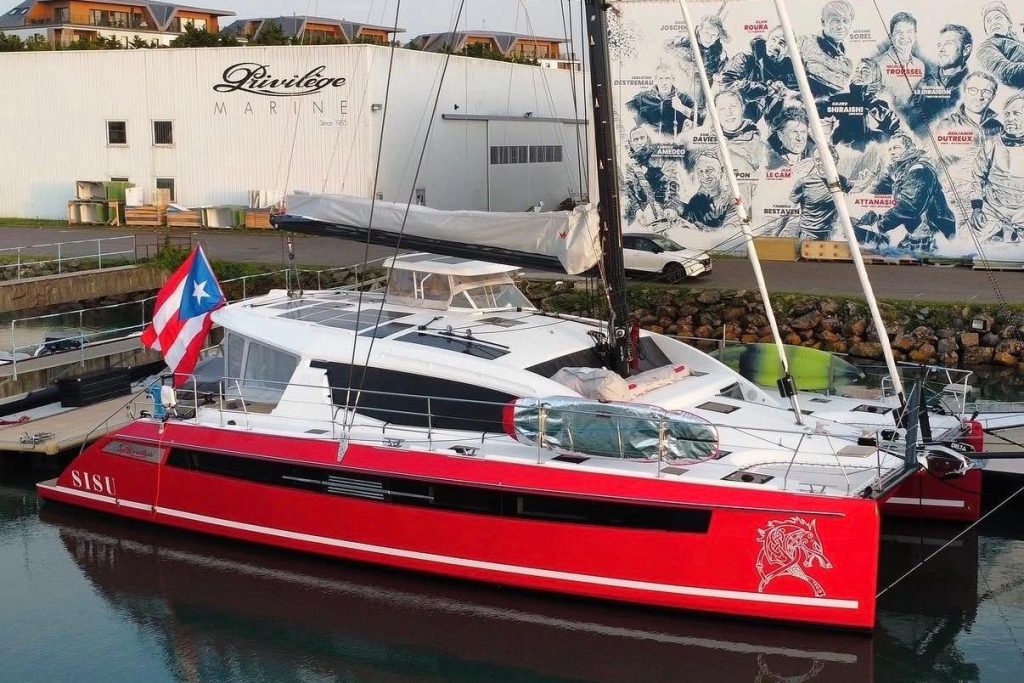
Every upgrade you can imagine — dual autopilots, 2.7kW of solar, a six-figure tender platform and a study where the full-beam master would be.

Some catamarans are sold on their layout drawings. Others have to be walked. Broker Mark Wattrus spends the better part of a full-length video walking S/V Sisu, a 2022 Privilege 510 Signature, and the impression that builds is of a boat that has been thought about hard by an owner who actually used her — including several Atlantic crossings with the captain who commissioned her from the factory and has been aboard since new.
That captain, Wattrus notes at the outset, knows Privilege’s build and after-sales team and remains a genuine resource for a buyer. It’s an unusual piece of continuity for a three-year-old bluewater cat, and it colours the rest of the tour: this is a boat where the systems story is as interesting as the joinery.
Cockpit and helm: built for weather
The aft cockpit is bright and open, floored in teak, with deep storage hatches underfoot and more beneath the seating. Wraparound Isinglass with shade netting encloses the space, and a large folding teak table converts from coffee table to full dining setup. Two big hatches recessed into the cockpit coachroof handle ventilation.
Teak steps lead up to the helm, where a padded seat with backrest, armrests and drink holders sits behind a fully enclosed hardtop bimini and a proper built-in hard spray hood. Wattrus relays the captain’s line about sitting up there in 45 knots and feeling nothing until you unzip the enclosure — a claim the hardware makes easy to believe.
The electronics deserve their own paragraph. Sisu carries both Raymarine and B&G packages, deliberately, for redundancy: two completely separate autopilots on different backbones and different systems, plus a bank of plotters across the helm pod. Throttle controls for the Yanmar engines are electric, the two-speed winches are electric and controllable from the helm as well as the cockpit, and all lines and clutches lead aft.
Decks, tender platform and solar
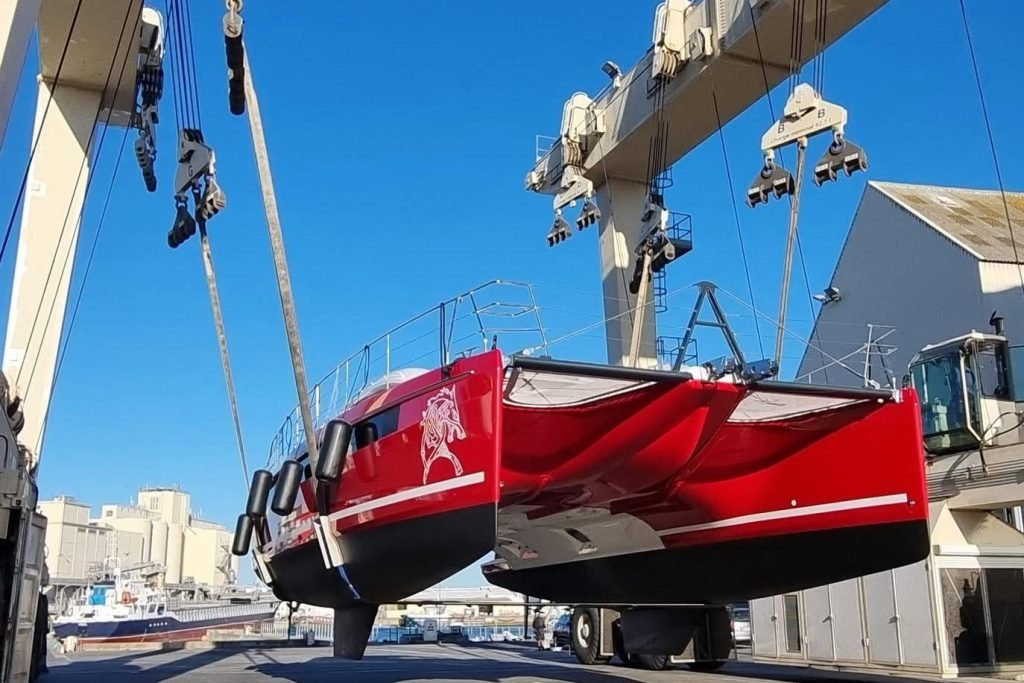
Rather than davits — common on the 510 — this owner specified a dive and tender platform that Wattrus describes as a six-figure upgrade, lifting the tender clear of the water and well above the bridgedeck. The tender itself is an AS with a centre console, bench seat and a 20hp Suzuki four-stroke. Aft you’ll also find a stainless and teak dive ladder, a huge sugar scoop, custom rod holders and heavy cleats.
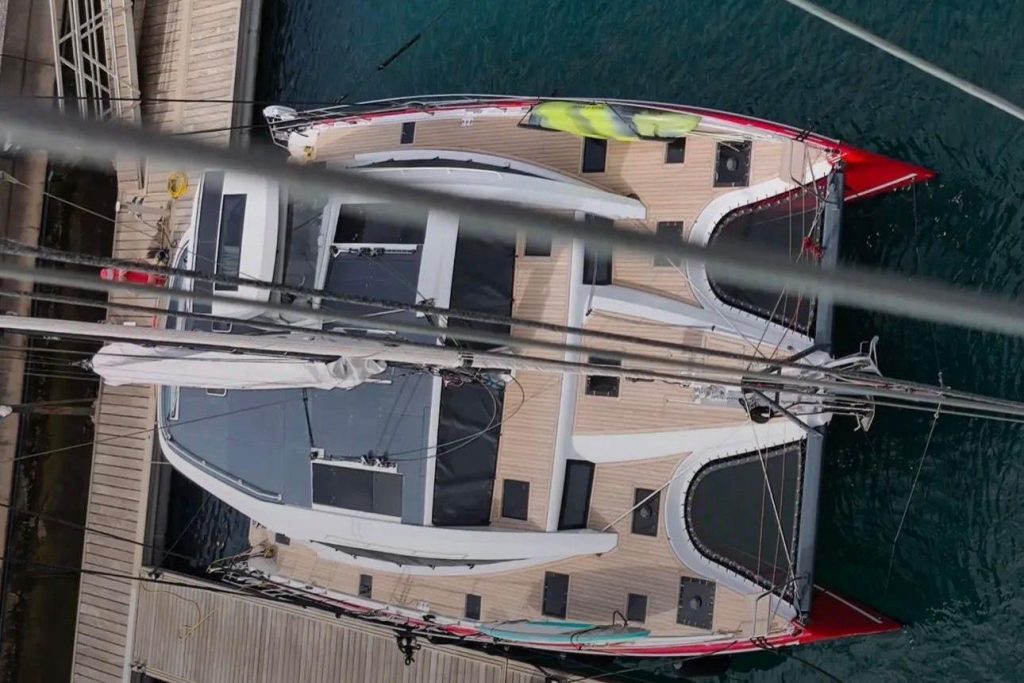
Side decks are teak the whole way forward, with solid stainless lifelines, load sensors on the shrouds so rigging loads can be monitored, custom shade netting over the windows and a kayak stowed on its own custom mounts. Sails are Hydranet, with two electric furling headsails — staysail and genoa — on Profurl units, and an asymmetric spinnaker flown from a large bowsprit. Forward there are two windlasses and two anchors, again for redundancy, and brand-new custom trampolines.
Aftermarket solar totals 2.7kW, split between the coachroof and the hardtop, with panels you can walk on. Wattrus makes a point of the aesthetics: no arch on the transom, so the boat still reads as a yacht, while the captain reports charge figures well over 100 amps at times. Custom cushions turn the coachroof into a lounging area at anchor.
Saloon and galley
Inside is where Wattrus argues Privilege separates itself from the average production catamaran, and the fit and finish backs him up. Underfloor storage is extensive and doubles as access to systems, including a lithium-ion battery installation he calls out specifically after going through the electrical with the captain.
The saloon has an electric coffee/dining table that drops to form a full berth, a large swivelling flat screen, and a clever hatch arrangement — openings placed to port and starboard on the coachroof rather than at the windows, plus an enormous hatch on centreline below the boom to channel air through. To port sits a full nav table with a large Raymarine MFD, Iridium satellite communicator, Fusion audio, USB charging, VHF and autopilot controls.
The galley steps down and is fitted with Miele appliances throughout: oven, convection microwave, dishwasher, washer/dryer in the starboard passageway. The cooktop is half propane, half induction — a genuinely sensible world-cruising hedge. There’s a farmhouse sink with separate UV-filtered drinking water, two fridges plus additional fridge-freezer cold storage, and a further chest-height fridge and freezer down in the port hull.
An owner’s version of the four-cabin layout
Sisu skips the full-beam master. The owner instead took a starboard master forward of a starboard aft guest suite, and Wattrus explains the reasoning: he wanted a proper master bed but didn’t want it occupying the full beam or sitting directly on the bridgedeck during passages — and wanted the option of moving aft to the guest berth in heavy weather.
What results is a suite with its own door, drawers and cabinetry, a bench seat with storage, custom mattresses, a deep book nook alongside the bed with fan, reading lamps, dimmer and charging ports, and ventilation forward and in the passageway that Wattrus reckons removes the need for air conditioning in a tropical breeze. The master shower has an overhead rain head, portable faucet and good natural light.
To port, the forward cabin has been turned into a study — desk, drawers, recessed storage, charging station, printer — alongside a queen island berth, plus custom shelving so deep Wattrus can’t reach the back of it. Bedding storage fills the space the full-beam master would have taken. The starboard aft guest suite has a double-door shower with teak sole and a separate air-conditioned head.
Machinery
Yanmar 4JH8 diesels with 1,600 hours sit in engine spaces you can climb down into and stand in, with lighting and access to both sides. Sisu carries complete spare rudders — rare on any boat — and the shaft seals have just been replaced. Also aboard: dual Racors with changeover, an additional water separator, accumulator tank, fire suppression, Webasto air conditioning, a dive compressor and a high-output watermaker with high-pressure pump.
A final detail says a lot about how the boat was lived on: roughly $10,000 of custom safety netting that wraps the entire boat along the guardrails and continues into the saloon and galley, with a bed protector too — all specified so an infant could play aboard safely.
Where the 510 sits
For context, YachtSite’s own figures on the model show a thin, high-value market.
| Recent solds (24 mo) | 2 |
|---|---|
| Median sold price | $1,345,000 |
| Median time to sell | ~405 days |
| Active listings | 2 |
| Asking range | $1,399,000–$1,749,000 (median $1,574,000) |
| Median sold (24 mo) | $1,345,000 | |||
| Median asking (active) | $1,574,000 | |||
| Lowest asking | $1,399,000 | |||
| Highest asking | $1,749,000 |
Boats trade infrequently and take time; buyers shopping this segment are generally comparing a small handful of hulls at once, which makes specification and provenance — exactly what Wattrus spends the video documenting — the deciding factors.