
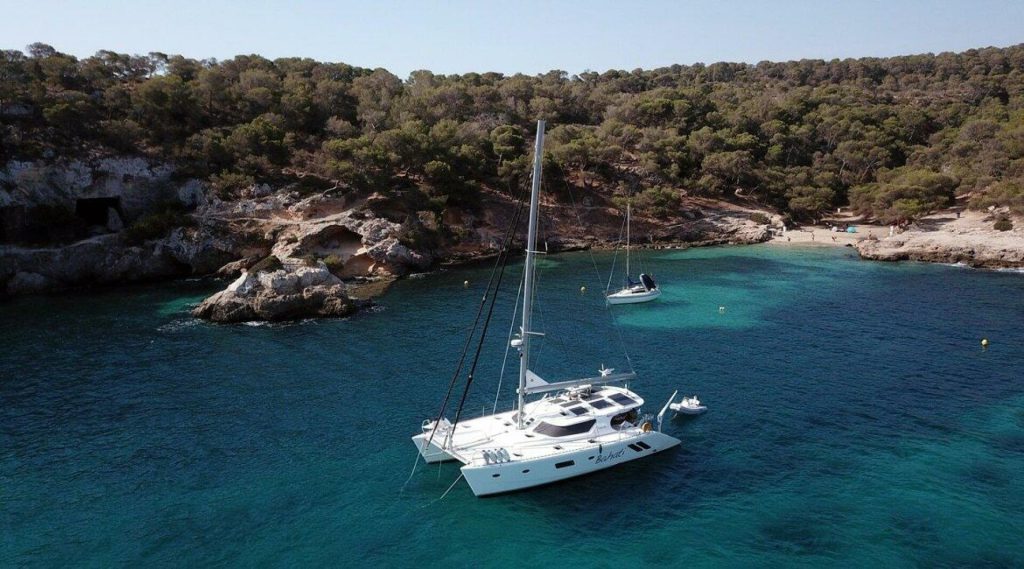
A guided factory-rep walkthrough of the semi-custom South African catamaran behind S/V BAHATI — four boats a year, no interior moulds, and a standard kit list most cats charge extra for.

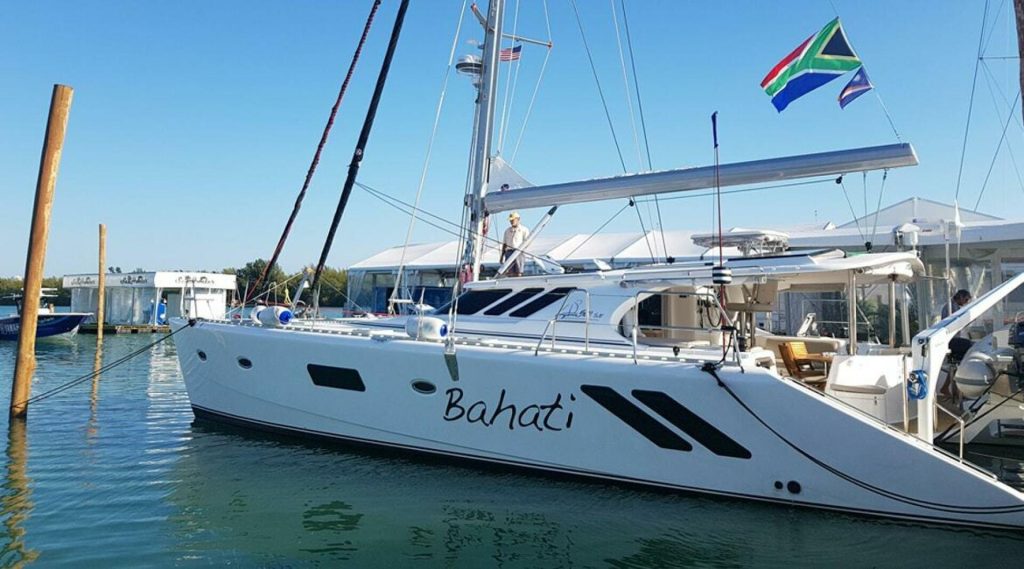
Some catamarans announce themselves from a mile off. The Knysna 500SE is one of them — a low, slanted-window profile that, as the builder’s representative puts it in this walkthrough, draws the anchorage question: “where’s that boat come from?” The video that accompanies this listing is a full guided tour of a Knysna 500SE, filmed at the Annapolis Sailboat Show by cruising couple Craig and Janice of Cruising Off Duty, with Kevin Fouché of Knysna Yacht Company doing the honours. It’s a useful piece of homework for anyone considering S/V BAHATI, the 2018 Knysna 500SE Owner Version listed here with Tony Brewer.
One caveat up front: the boat in the video is a show boat, not BAHATI herself. But because Knysna builds only four hulls a year and treats every one as semi-custom, the tour is less a spec sheet than an explanation of how these boats are built — which is exactly the context a buyer needs when evaluating any individual example.
A cockpit built for the long haul
The tour starts aft, where the cockpit seats eight around a table under a solid hard roof, with roll-down sides for weather. There’s a braai (the South African barbecue that Fouché says comes on every South African boat), a cockpit cooler, an ice maker to port with a small bar top to serve from, and a transom shower and swim ladder. The decking is Flexiteek — standard, not an upgrade — and both hosts single it out as one of the boat’s best features: soft underfoot, cooler than fiberglass in the tropics, and free of the sanding and maintenance real teak demands.
The tender sits on blocks at the transom rather than swinging from davits, lifted at the push of a button from the helm. Craig makes the case for this arrangement in his wrap-up: a dinghy strapped down on blocks is far less likely to end up dragging astern after a line fails mid-passage.
One helm, two hands
The helm is a single starboard station — “the molehole,” as some call it — and Fouché makes no apology for it. Sightlines are the argument: you can see both bows when docking and both sugar scoops when backing down, which is not true of every 50-foot cat. Electric winches, an electric furler, anchoring with chain counter, tender lift and the screecher on a foot switch all live here, the point being that a couple can run the boat without leaving the station. Garmin instrumentation is the standard fit, and Craig notes approvingly that the standard screens are large enough that he wouldn’t feel the need to upgrade — not always the case when a builder quotes “standard electronics.”
A sliding glass panel closes over the helm in bad weather, and combined with the roll-down enclosure the whole aft end can be shut in. Craig’s one real criticism, offered as nitpicking, is the absence of a hard dodger or windscreen forward of the helm — he’d rather have rigid protection than clear vinyl, which fogs and goes brittle with UV. Janice’s only complaint is the swim ladder, which she found narrow and flexy for anyone climbing out in dive gear.
Built light, built visible
The most interesting part of the tour is structural. There are no interior moulds in this boat and no liners. Cabinetry and bulkheads are built from 10mm Airex foam and skinned in the veneer of the owner’s choice — oak on the show boat, with a good deal of solid timber trim and lattice-front lockers that Janice loved. Fouché argues the exposed hull structure is a feature, not a shortcut: any stress from working in a seaway shows up where you can see it, rather than hiding behind a panel. It also keeps weight down. The all-up figure quoted is 13.5 tonnes fully kitted, with a comfortable running range of 11–13 knots. “We’re not building a racing boat,” Fouché says, “but when need be, she must be able to pick her legs up and move.”
Weight distribution gets the same attention: fuel (600 litres), water, batteries and the generator are grouped near the middle of the boat to keep her from hobby-horsing.
The three-cabin owner’s layout
The show boat, like BAHATI, is a three-cabin Owner Version — two double en-suite cabins to starboard, the entire port hull given over to the owner. Berths sit on top of the bridgedeck rather than down in the hulls, which raises them but preserves bridgedeck clearance. A newer addition is an extra hull window at berth level, so you can look out while lying down.
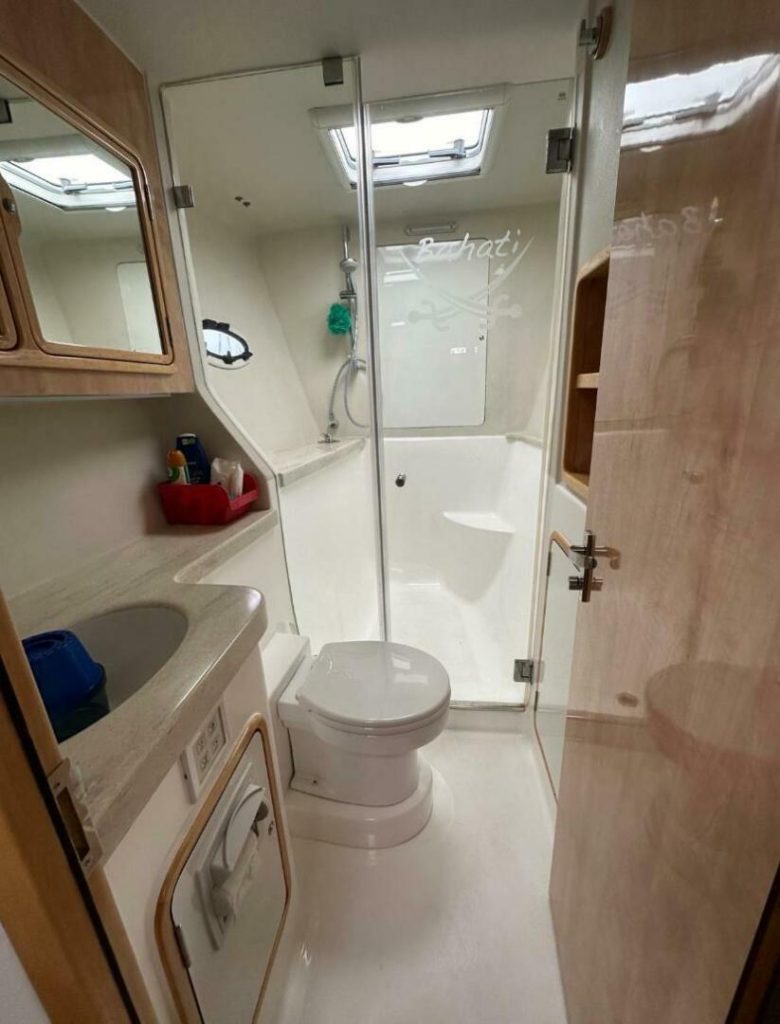
Headroom is generous; Fouché, at 6’4″, uses himself as the measuring stick and has clearance to spare. The forward guest head has a shower big enough for two, with an opening escape hatch and a deck hatch overhead. Toilets are electric with fresh-water flush.
In the owner’s hull, the space forward of the berth on the show boat has been turned into a study — a desk, a seat, air conditioning, a door that closes for privacy, and a TV that can mirror the navigation display. Fouché notes it’s become the layout most owners copy. Forward of that is the vanity, and behind a closing panel, a dedicated systems room housing the generator, watermaker and inverter — all at chest height rather than buried in an engine bay. Craig flagged this as one of his favourite details on the entire boat.
The galley and saloon
The galley is galley-up and, again, negotiable in layout. The show boat had a dishwasher, twin sinks (one serving as a drying area and cutting board), a microwave, and a top-fed bin with the chute integrated into the counter. Fouché mentions the builder will cut holes to fit an owner’s specific mugs and glassware — a small illustration of what four-boats-a-year actually means. Convection ovens and induction hobs are common alternatives to propane. The saloon table drops on gas struts to form a large berth, useful for off-watch sleeping close to the cockpit, and storage is worked into every available void.
Deck and rig
Side decks are wide and flat, with grab rails on the steps up and two routes onto the coachroof. Solar is 800 watts as standard. The mast stands 18 metres off the deck, roughly 21 metres above the water — with a shorter rig offered for ICW cruisers — and an in-boom furler is available in place of the standard furler. Forward, the trampolines and “princess seats” earned Janice’s approval, and access hatches lead to the fuel tank (with room for jerry cans) to port and the water tank to starboard.
What it all costs
Asked on camera, Fouché put the show boat at $895,000 as she sat — lithium batteries, generator, watermaker, air conditioning, tender, electric furler, screecher, washer-dryer, the lot. “There’s nothing to add,” he says. That was a new-build price quoted at the 2019 show, not a figure for this listing, but it frames where the model sits. Lithium, he notes, had by then become standard.
For context on the used side of the ledger, YachtSite’s own figures for the Knysna 500 show a thin but steady market:
| Metric | Figure |
|---|---|
| Solds, last 24 months | 2 |
| Median sold price | $787,450 |
| Median time to sell | ~294 days |
| Active listings now | 2 |
| Asking range | $795,000 – $799,000 |
| Median sold (24 mo) | $787,450 | |||
| Median asking (active) | $797,000 |
With only a handful of these boats built each year, opportunities to buy a three-cabin Owner Version don’t come around often. If the video leaves you convinced — as it did the couple filming it, whose only reservations were a swim ladder and a soft dodger — the next step is a closer look at this particular hull.